
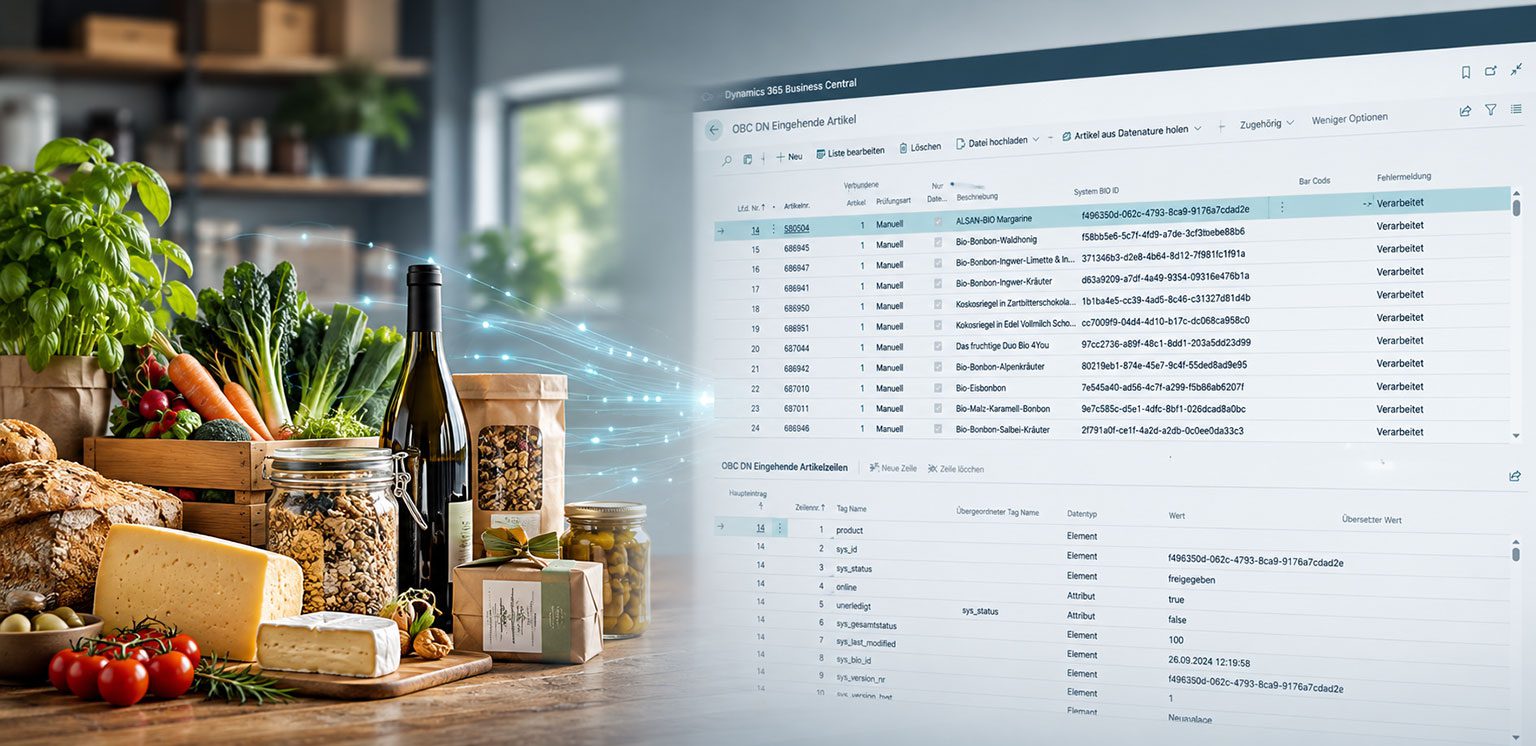
DATA NatuRe Meets Business Central: Product Data Without Duplicate Master Data Maintenance
There’s Always Something.
Anyone who has ever been involved in an ERP project will know the issue. Things tend to get interesting as soon as you get to the data. One product has no proper unit of measure, another is missing its weight, descriptions have been maintained inconsistently and, of course, somewhere there is still an Excel file containing information that nobody has anywhere else. In my view, master data is one of the biggest ongoing challenges in ERP systems. And unfortunately, it is not something you can simply ignore, because almost every process ultimately depends on it.
Things do not get any easier in food wholesale. Here, we also have to deal with allergens, ingredients, certificates, packaging units, weights and a whole range of product attributes. After all, a cheese is very different from a bottle of wine – including when it comes to product master data. With organic food, however, we have one small advantage. A lot of this information has already been maintained by someone else. And in a place where it actually makes sense: by the manufacturer.
With DATA NatuRe, there is a shared platform for product data in Germany’s organic food market. Manufacturers make their product information available there, allowing wholesalers and other market participants to work with it. That raised an obvious question for us: If the data is already there, why are we entering it into Business Central all over again? So we stopped doing that. And built an app instead.
Bringing Products into Business Central from DATA NatuRe
We did not want to make getting started any more complicated than necessary. A product in Business Central is linked to DATA NatuRe using its unique System-BIO-ID. This allows us to retrieve the available product information and bring it into Business Central. Now, you could of course say: an integration that transfers data from A to B. Congratulations. Unfortunately, it was not quite that simple. DATA NatuRe does not provide the same information for every product. A cheese, for example, has different relevant attributes from a wine. As a result, the data supplied can vary considerably. We therefore needed a way to handle this variety without having to involve development every time. That is why we built in a mapping function. Customers can define what should happen to information from DATA NatuRe once it reaches Business Central. A value can be transferred to a specific field, added to the units-of-measure table or, for example, created as a product attribute. I much prefer that to a rigid integration. Otherwise, as soon as the next product range comes along, there will inevitably be some piece of information nobody thought about beforehand. With master data, that is almost a law of nature.
What Was the Type of Salt in This Cheese Again?
There is something else we know all too well from ERP projects: the data is there. Nobody can find it. That is why we have also built a DATA NatuRe Viewer directly into Business Central. It shows the DATA NatuRe information available for a product. The information can be grouped and searched, for example by allergens or other product attributes. This is particularly useful when someone actually needs to work with the data. A customer calls and wants to know something about a product. I do not want to start wondering which field, page or table might contain that particular piece of information. I can simply search for the type of salt, for example, and see the answer. Whether the type of salt is the most important piece of information in food wholesale every day is debatable. But sooner or later, someone is guaranteed to ask.
Unfortunately, Master Data Doesn’t Stay the Same
At this point, we would already be in pretty good shape. The data comes from DATA NatuRe, we can map it in Business Central and users can work with it properly. But master data has one rather inconvenient characteristic: it changes. With a description, that may still be manageable. With an organic certification, things become more interesting. And when it comes to allergens, I certainly do not want to rely on someone eventually noticing by chance that a piece of information is no longer correct.
When data is retrieved again, the app can therefore compare what is currently stored in Business Central with what DATA NatuRe provides. Any differences are displayed, allowing the user to decide whether to accept the new value or keep the existing one. Depending on the configuration, data can also be updated automatically. What is still missing is an automated check across the entire product range. And I think that is important. If a wholesaler has 10,000 products, “Just check regularly to see whether anything has changed” is not a process recommendation I find particularly convincing. That is why we want to extend the app so that it can detect changes in DATA NatuRe automatically and respond accordingly. If, for example, a relevant certificate or another important piece of product information changes, this should become visible in Business Central without someone first having to remember to retrieve that particular product again. This automation is not currently part of the app, but is a planned extension.
For me, that is also the point where the solution becomes really interesting.
Maybe Less Master Data Maintenance Is Part of the Solution
In ERP projects, we spend a lot of time talking about how companies can improve their master data maintenance. Who is responsible? Who is allowed to change what? Which fields are mandatory? How do we ensure data quality? All perfectly valid questions. But sometimes the answer can be a little simpler. We stop maintaining certain data ourselves.
If the manufacturer already provides its product information through DATA NatuRe, we should use it. Our customers need this information in Business Central, so we bring it into the system and make it available for their processes. Of course, this does not suddenly solve every master data problem a food wholesaler has. If only it did. But it does allow us to remove some of those problems in a very pragmatic way.