
From Scepticism to Optimism: What I Learned About AI While Writing My Bachelor’s Thesis
When I chose the topic for my bachelor’s thesis, I initially had a primarily academic question in mind. Artificial intelligence was – and still is – one of the most widely discussed topics of our time. New technologies emerge almost every day, software providers are integrating AI features into their products, and there is often an impression that companies simply need to press the right button to start benefiting from them.
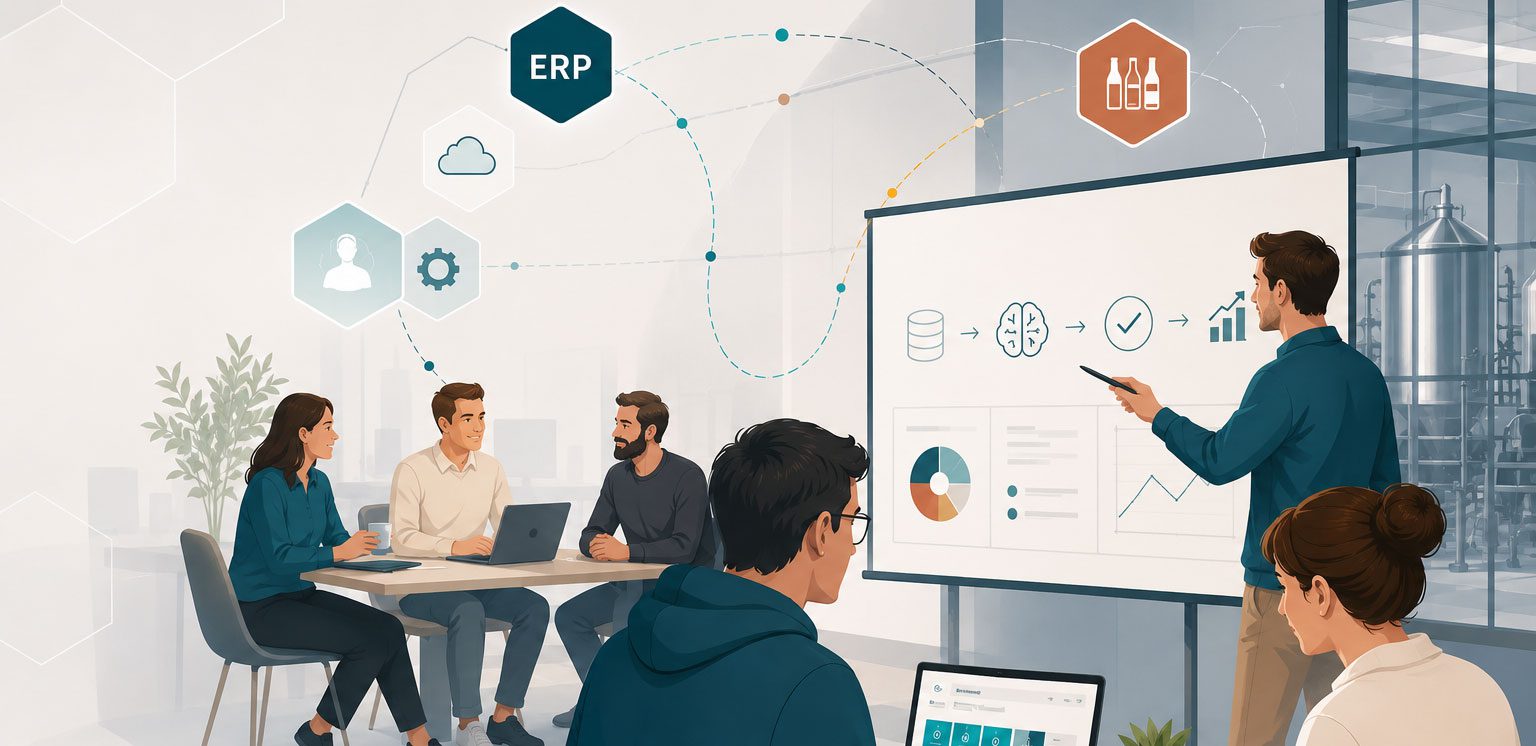
My bachelor’s thesis, entitled “AI-Supported Process Optimisation in ERP Systems in the Brewing Industry: Status Quo and Development Potential”, set out to explore exactly this question: What potential does artificial intelligence offer within modern ERP systems, and how far have companies already progressed on this journey? The deeper I explored the subject, the more I realised that the most interesting insights often emerge where theory meets practice. And that is exactly why I am considerably more optimistic about AI today than I was at the beginning of my research.
The Real Question Was: What Is Actually Happening in Companies?
Anyone exploring AI will quickly come across impressive examples. Fully automated processes, intelligent assistants and systems that appear to make decisions independently. But I was less interested in what was theoretically possible. What I found much more interesting was what was actually happening within companies. As part of my bachelor’s thesis, I therefore spoke with people responsible for different breweries and examined their current ERP landscapes, the role digital transformation already plays and where they see concrete potential for using AI. The brewing industry is a particularly interesting environment in this respect. On the one hand, it is a traditional industry with complex production processes. On the other, companies face many of the same challenges as other medium-sized businesses: increasing demands, skills shortages, growing competitive pressure and the desire to make better use of existing data. That is why I was particularly interested to hear what they had to say.
The Most Interesting Finding Wasn’t About Technology
At the beginning of my research, I expected the conversations to focus primarily on technical possibilities. Which AI models are particularly interesting? Which processes can be automated? What technological limitations still exist today? Of course, these topics came up as well. But much more often, the interviewees talked about something else.
- Data.
- Processes.
- Transparency.
And, surprisingly often, about the people who work with these systems every day. The more interviews I conducted, the clearer it became that companies certainly recognise the potential of AI. At the same time, those responsible are very aware that technology alone does not solve problems. The much more important question is how it can be used effectively. I found this perspective particularly interesting because it shows that many companies are approaching AI far more pragmatically than the current hype might sometimes suggest.
AI Is Already Here – Just Not in the Way Many People Think
When people talk about AI, many immediately think of fully automated processes or systems that make decisions independently. In my conversations with experts, however, this played a much smaller role. Instead, AI was often seen as a tool for supporting people. Finding information faster. Identifying relationships. Improving data quality. Detecting errors at an early stage. Reducing employees’ workload. The more I thought about it, the more sense this perspective made to me. Because this is often where the greatest value can be found. Not in spectacular visions of the future, but in lots of small improvements to everyday work. If an employee can find information more quickly, that saves time. If master data is checked automatically, fewer errors occur. If relationships become visible earlier, better decisions can be made. That may sound less spectacular than the idea of fully autonomous production control. But for companies, it can deliver considerably greater value. You could also put it this way: not every innovation has to change the world. Sometimes it is enough if it makes Monday morning a little easier.
Why Modern ERP Systems Play a Key Role
My interviews also highlighted just how important modern ERP systems are for this development. Many companies are currently going through a period of modernisation. Legacy systems are being replaced, processes standardised and data made centrally available. One interviewee, for example, described a planned migration from Microsoft Navision 2009 to Microsoft Dynamics 365 Business Central SaaS. For many companies, projects like these are initially simply traditional ERP projects. During my research, however, I realised that they are also laying the foundation for many future AI use cases. The better structured, accessible and interconnected the data is, the greater the opportunities to use that information intelligently later on. That is why I no longer see modern ERP systems simply as tools for managing business processes. They are increasingly becoming the central platform for data-driven decision-making.
From University to Development and into Consulting
What I find particularly interesting is that I now encounter many of these insights in my day-to-day work as well. My journey at OTE originally began in development. There, I learned how Business Central works from a technical perspective, how processes are implemented and what challenges arise when business requirements have to be translated into software. That experience gave me a strong technical foundation. At the same time, I realised that I was interested not only in the technical implementation, but above all in understanding why companies have certain requirements and how technology can help them address those challenges.
After completing my degree and bachelor’s thesis, I therefore moved into consulting and now support customer projects as a Consultant and Project Assistant. This change in perspective is extremely valuable in my work today. Discussions about digital transformation, AI or automation are much easier to assess when you understand both the technical and the business perspective.
Why I’m Particularly Looking Forward to the Next Few Years
During my bachelor’s thesis, I explored the potential of AI in depth. Today, I have the opportunity to see many of these topics gradually becoming a reality. I am particularly interested in the current development of AI agents within the Microsoft platform. Many companies are still at the beginning of this journey, but that is precisely what makes the topic so interesting.
- How can agents support employees in their everyday work?
- Which tasks can be meaningfully delegated?
- Where do they create genuine value, and where are we simply looking at a short-lived trend?
These questions now occupy me almost every day. And that is exactly what makes the subject so interesting to me. It is not about adopting every new technology as quickly as possible. It is about finding out where technology genuinely supports people and improves processes. Many of the questions I explored in my bachelor’s thesis are already appearing in our first customer projects. The only difference is that we are no longer talking about theoretical potential, but about very specific use cases.
My Takeaways
Looking back over the past few months, my perspective on AI has changed considerably. At the beginning of my bachelor’s thesis, my main question was what technological possibilities existed and how realistic the many promises surrounding AI actually were.
Today, I am much more interested in a different question: What specific problems can we solve with these technologies?
The interviews showed that many companies are already taking their first steps. They may not always be spectacular, but they are often highly practical and deliver clear value. That is precisely why I am more optimistic about AI today than I was at the beginning of my research. Not because I believe AI will solve every challenge, but because I have seen how many companies have already started exploring its potential – and how much can be achieved when technology, processes and people work together effectively.
The most important insight from my bachelor’s thesis ultimately was not technical at all. It was human. The companies I spoke with are not waiting for technology to solve all their problems. They are looking for ways to support their employees, make better decisions and make better use of the knowledge they already have. That is where I see the greatest opportunity for AI. Not as a replacement for people, but as a tool that helps them do their work more easily, efficiently and with better information. And perhaps that is exactly why I am considerably more optimistic about AI today than I was at the beginning of my bachelor’s thesis.