
Why We Might Spend More Time Talking to Our ERP Than Clicking Through It in Five Years
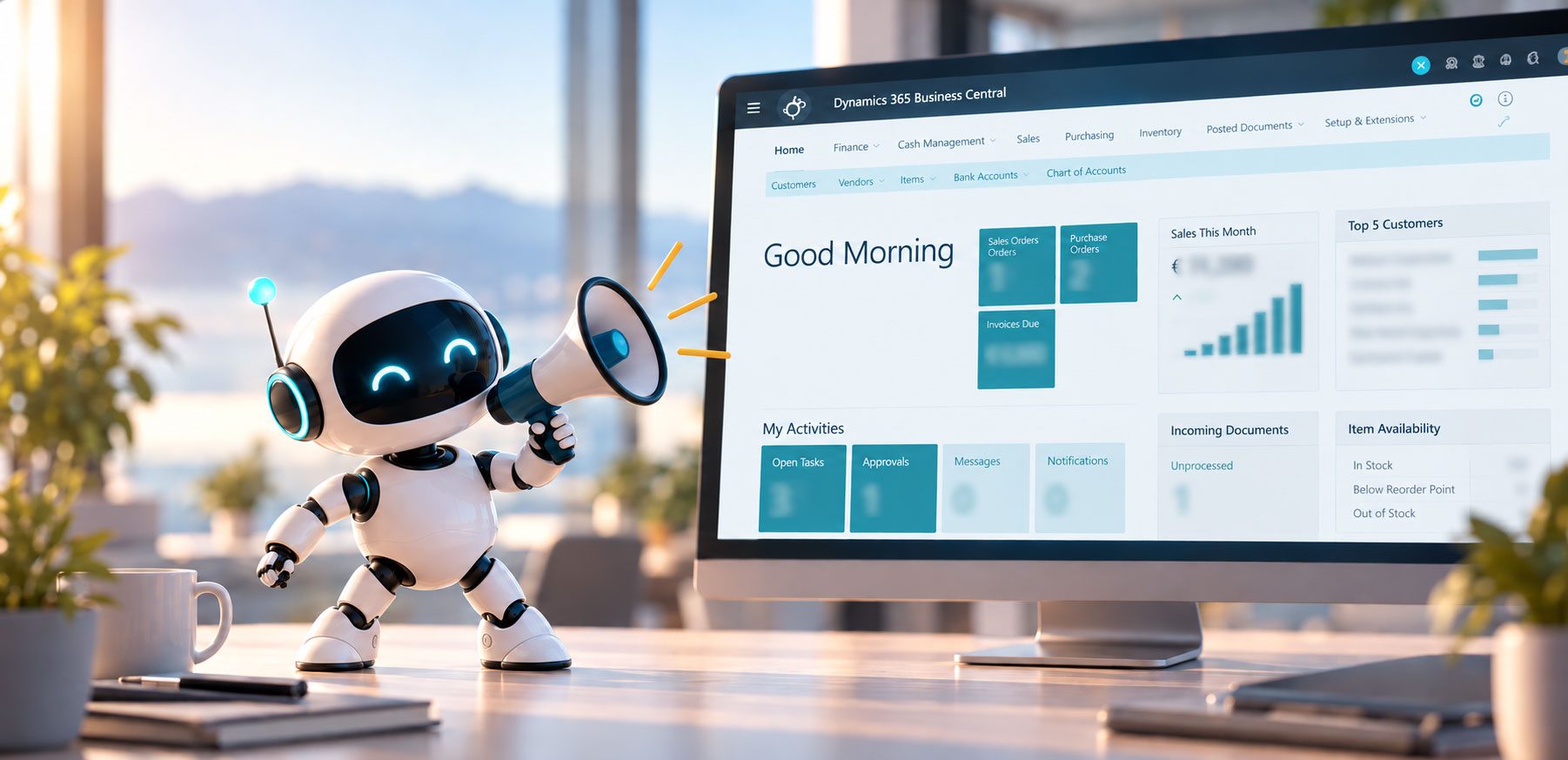
About two years ago, I was on stage at a panel discussion about AI and ERP. I described a scenario that, at the time, still felt some way off. I arrive at the office in the morning, grab a coffee and, before I have even opened Business Central, my assistant tells me what happened the day before. Not with twenty different KPIs, but with the things that actually matter to me: order intake is down, three key customers have ordered less, and for one of them, this could be related to the delivery issues we have had over the past few weeks. I immediately get suggestions for what we could do about it. I ask a few questions, make a decision and say: “Okay, let’s do that.”
And now comes the really important part:
I do not then open Business Central, find the right page and carry out my decision there. My agent does it for me. Two years ago, that was a vision. Today, I believe this is pretty much exactly where we are heading.
Why Are People Still Searching for the Problem?
Take a planner working in a warehouse. Today, their working day might begin with inventory lists, open purchase orders, sales orders and demand requirements. They apply filters, check stock coverage and delivery dates, and try to work out from all this information where problems might arise over the next few days. The ERP provides the data. The person searches the data for the problem. Why shouldn’t they simply ask their agent: “Where are we likely to run into problems over the next two weeks?”
The agent knows the inventory levels, open orders, expected goods receipts, historical consumption and lead times. Instead of turning all of that into yet another long list, it could say: “Five products are becoming critical. Product A has enough stock for another six days, and the supplier has been late several times recently. I would bring the next order forward.” The planner no longer has to search for the problem. It comes to them – together with a recommendation. And if they agree, perhaps all they need to say is: “Do it. And increase the quantity so that we have four weeks of stock coverage again.” Why would they need to open a purchase order page after that?
The ERP Is Not Going Away
I have been working with ERP systems for almost 30 years now. We have changed a great deal during that time, but we have remained remarkably consistent about one thing: people have to learn how to use the ERP system. We optimise pages, fields, role centres and click paths. That makes sense today. But I doubt that, five years from now, this will still be equally important for every user. Business Central will not disappear as a result. Quite the opposite. In the background, agents need a reliable system that accurately manages inventory, prices, orders, postings, permissions and business logic. The more an agent is expected to take on, the more important reliable ERP data and processes will become, in my view. It is the interface that will change.
Perhaps the ERP itself will soon no longer be the most important interface to the ERP.
Fewer Operators, More Decision-Makers
And yes, this will also affect the way we work. If people currently spend a significant part of their day gathering information from screens, transferring data, reviewing lists and repeatedly deriving similar actions from them, AI will take over some of that work. In my view, it would not be particularly credible to predict enormous productivity gains from AI while claiming that we will still need the same number of people to do the same work afterwards. We will need fewer people whose main task is to operate an ERP process step by step.
Instead, we will need people who can make decisions and are willing to make them. People who can assess recommendations, understand the bigger picture and take responsibility. People who can tell an agent: Do this. Don’t do that. Or: Explain to me first why you are recommending this. Roles that mainly consist of entering information into ERP screens will therefore gradually become less relevant.
We Need to Rethink ERP Too
For us as an ERP provider, this means we can no longer look at processes solely in terms of how best to represent them in Business Central. We need to ask ourselves more often: What would this process look like if the person no longer had to operate Business Central step by step? Where should an agent recognise that something has happened? Where should it issue a warning? Which actions should it recommend, which should it prepare, and which might it eventually carry out autonomously?
We need to develop scenarios like these together with our customers – and sometimes think a step ahead for them. If a planner has opened the same inventory list every morning for the past 15 years, the obvious first thought is to make that list better. But perhaps they do not need a better list at all. Perhaps, eventually, they will not need a list anymore. Two years ago, my morning ERP assistant was still an idea for a panel discussion. Today, many of the building blocks required to make it a reality already exist or are being developed. In five years, ERP systems will therefore probably not be any less important. We will simply spend significantly less time operating them.
Perhaps what we are witnessing is not the end of ERP at all. Perhaps it is simply the end of the ERP interface as we have known it for decades.
Further Reading:
Our article “Thanks, EU! Finally, a Really Good AI Use Case for Our ERP” shows what the path towards less manual ERP work can already look like today. It explores a task where people still have to extract information from documents and transfer it into the ERP system – and how an AI agent can support exactly this process.
Thanks, EU! Finally, a Really Good AI Use Case for Our ERP